Are Peptides Legal? What Albuquerque Patients Should Know

Some peptide medicines are legal in Albuquerque when prescribed and supplied through legitimate medical channels; others sold for recovery, weight loss, or “anti-aging” lack FDA approval or a lawful route to routine treatment. The answer depends on the exact product, its intended use, and how it is manufactured and dispensed—not simply whether it is called a peptide. Understanding those distinctions helps you evaluate treatment offers without confusing a prescription, a research label, or a clinic advertisement with regulatory approval. (fda.gov)
Are peptides legal in Albuquerque?
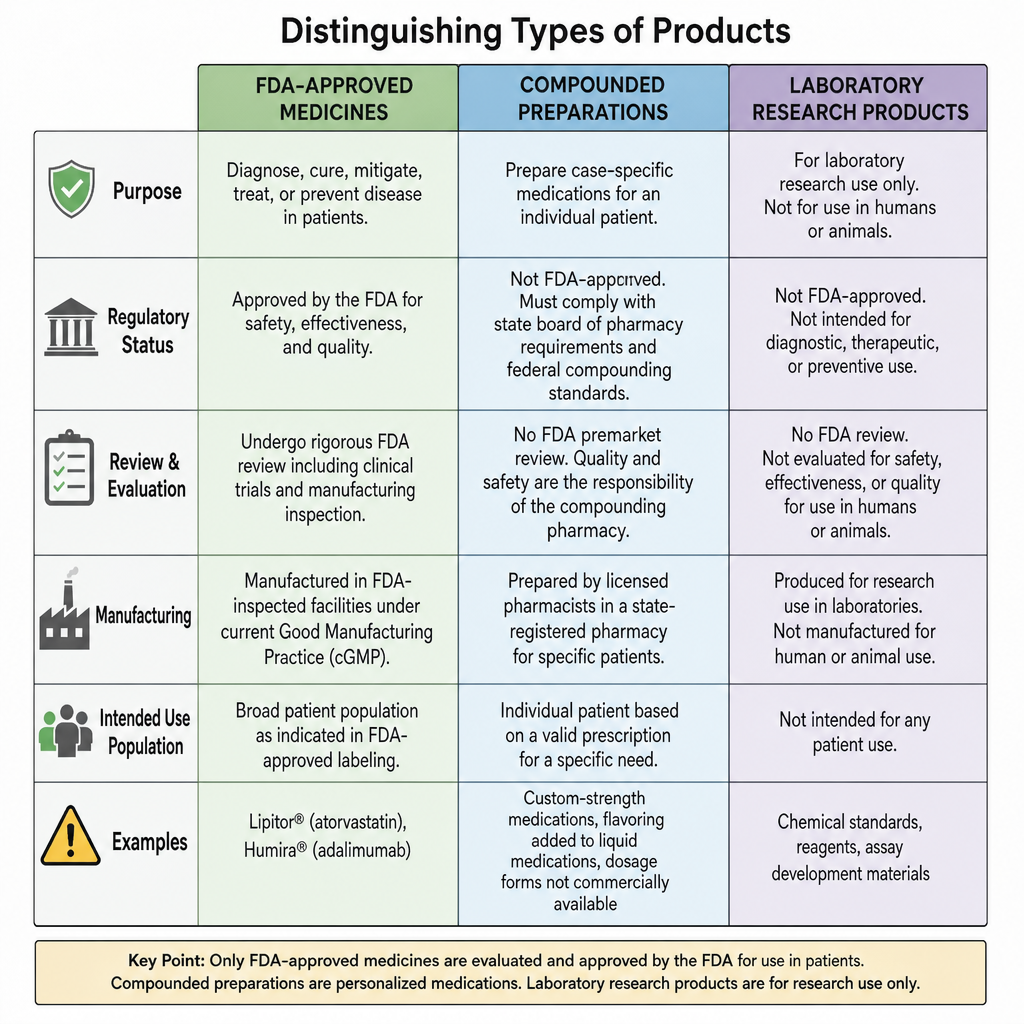
Yes, certain peptide medications are legally available to Albuquerque patients, but peptides do not have one blanket legal status. FDA-approved medicines, qualifying compounded preparations, and laboratory research products fall into different regulatory categories. Federal drug requirements and New Mexico prescribing rules both matter. (fda.gov)
For patients researching peptides legality in Albuquerque, these three categories provide a useful starting point:
- FDA-approved medications: Products such as Wegovy, containing semaglutide, and Zepbound, containing tirzepatide, have FDA-approved medical uses. Their approval applies to specific manufactured products, not every vial advertised with the same ingredient name.
- Compounded medications: Certain drugs can be prepared under federal and state compounding requirements to address a patient's medical needs. Compounded products are not FDA-approved, and not every peptide ingredient qualifies.
- Research products: A chemical marketed for laboratory investigation is not thereby authorized for patient treatment. A research disclaimer does not protect a seller from drug laws when its marketing establishes intended human use. (niddk.nih.gov)
Be cautious with sweeping statements such as “all peptides are banned” or “peptides are legal because they aren't controlled substances.” Neither answers whether a particular product can lawfully be marketed, prescribed, compounded, or dispensed. Ask the clinic to identify the exact medication and the regulatory basis for providing it. (fda.gov)
FDA approval, compounding, and off-label prescribing are different
FDA approval means the agency has evaluated a particular drug's safety and effectiveness for its approved uses. It does not mean the medication is risk-free or appropriate for everyone. Approved labeling explains indications, dosing, warnings, and other information clinicians use when weighing treatment options. (fda.gov)
Off-label prescribing is another concept. Clinicians generally may prescribe an FDA-approved drug for an unapproved use when medically appropriate, although FDA has not established safety and effectiveness for that use. That is different from treating an unapproved research product as an approved medicine. (fda.gov)
Compounding has its own requirements. Under section 503A, qualifying compounded drugs generally depend on valid patient-specific prescriptions, and bulk ingredients must meet applicable eligibility criteria. A clinician's willingness to write a prescription does not independently make an ineligible ingredient lawful to compound. (fda.gov)
For example, a patient might need a formulation without an ingredient that causes an allergy. Compounding can help address such needs, but it is not simply a substitute for FDA approval. Ask why a compounded preparation is necessary rather than accepting “customized” as a sufficient explanation. (fda.gov)
Do you need a prescription for peptides?
For prescription peptide medicines used in medical treatment, yes: you need a valid prescription from an appropriately licensed clinician. Patient-specific compounding under section 503A also requires a valid prescription. However, having a prescription does not erase restrictions on the ingredient, manufacturing process, or source. (fda.gov)
The word “peptide” alone is not enough to determine prescription requirements. Ask for the actual drug name and formulation, then confirm whether the proposed product is FDA-approved or compounded. If a seller offers an injectable prescription treatment without screening or a prescription, FDA identifies that as a warning sign. (fda.gov)
New Mexico telehealth requires meaningful medical care
For physicians and physician assistants, New Mexico rules generally prohibit prescribing without an established physician-patient relationship, including prescribing based solely on an online questionnaire, subject to specified exceptions. The rules describe a face-to-face telehealth pathway using standard videoconferencing, with medical history, informed consent, documentation, and appropriate examination arrangements. (srca.nm.gov)
That does not justify a blanket claim that every prescribing profession and every clinical situation follows an identical video-visit rule. Requirements depend on the clinician and circumstances. Ask how the provider will establish care, whether an in-person examination is needed, and who will handle follow-up; physicians treating New Mexico patients remotely must also have appropriate authorization to practice. (srca.nm.gov)
How to get prescribed peptides through legitimate care
Start with the health problem you want evaluated—not a product you saw advertised. Bring your symptoms, treatment goals, medication list, relevant diagnoses, and previous treatment history. New Mexico's Board of Nursing guidance emphasizes medical evaluation, informed consent, appropriate testing, and ongoing monitoring for GLP-1 treatment. (bon.nm.gov)
Use this appointment checklist:
- Verify the prescriber. Check physicians and physician assistants through the New Mexico Medical Board; use the relevant professional board for other clinicians. Confirm the individual who will actually prescribe, not just the clinic's medical director. (nmmb.state.nm.us)
- Request the exact product name. Ask whether it is an FDA-approved medication or a compounded preparation. If compounded, request the medical reason and confirmation that compounding is legally permissible. (bon.nm.gov)
- Identify the dispensing pharmacy. Obtain its name before paying and verify its licensing through the New Mexico Board of Pharmacy. Do not rely solely on a logo displayed on a clinic website. (rld.nm.gov)
- Agree on monitoring. Discuss expected benefits, adverse effects, follow-up, dose changes, and reasons to stop. Testing should match the medication and your clinical situation rather than a universal “peptide panel.” (bon.nm.gov)
- Clarify the full financial commitment. Request written estimates for visits, medication, supplies, laboratory work, and follow-up. Ask your insurer about coverage for the specific proposed treatment before committing. (fda.gov)
A useful consultation should leave you understanding both the recommendation and its alternatives. Ask what evidence supports treatment for your particular goal and whether an approved option could meet the same need. A prescription should follow clinical judgment, not substitute for it. (fda.gov)
Are research grade peptides safe or legal for personal treatment?
A “research grade” label does not establish safety, FDA approval, or lawful availability as a patient treatment. FDA evaluates intended use using evidence such as marketing claims, not just disclaimers. In an August 24, 2026 warning letter, the agency identified research-labeled peptide products as unapproved new drugs based on their intended human use. (fda.gov)
Safety concerns also vary by substance. FDA has flagged BPC-157 for potential immune reactions and peptide-related impurities, alongside limited safety information. For CJC-1295, the agency has identified serious adverse events including increased heart rate and systemic vasodilatory reactions. These are not interchangeable products with a single safety profile. (fda.gov)
A seller's purity claim does not answer every question about an injectable product's quality. Contamination and incorrect ingredient strength can cause serious harm, including with poorly compounded drugs. Ask who manufactured and dispensed the product rather than treating a laboratory-style label as sufficient reassurance. (fda.gov)
Avoid assuming that buying an unapproved peptide automatically creates the same criminal exposure as possessing a controlled substance. Marketing, importation, dispensing, and possession are distinct legal questions. FDA's warning letter addresses seller conduct; it is not a universal statement about patient criminal liability. (fda.gov)
Warning signs when comparing Albuquerque providers
A local office, professional-looking website, or “medical supervision” claim does not replace product verification. FDA advises patients to watch for misleading compounded-drug claims, missing screening, questionable labels, and unavailable follow-up care. (fda.gov)
Pause before purchasing if a provider:
- Calls a compounded product “the same as” an FDA-approved medicine.
- Cannot identify the pharmacy supplying your medication.
- Offers prescription medication without an appropriate evaluation.
- Provides no licensed clinician to answer questions after treatment begins.
- Cannot explain why compounding is needed or whether it is permissible. (fda.gov)
Peptide laws and compounding policies require ingredient-specific checking. FDA advisory review of a substance is not itself approval of a finished medication. If a clinic cites regulatory changes, ask for the applicable policy rather than relying on a headline. (fda.gov)
The practical takeaway
Legal access starts with an identifiable medication, an appropriate medical evaluation, and a legitimate dispensing source. Before starting treatment in Albuquerque, verify the clinician and pharmacy, understand whether the product is approved or compounded, and agree on follow-up. If those answers remain unclear, pause and seek another medical opinion. (fda.gov)
Read More Blogs!
Stay updated with the latest blog posts and engage with our community.